Monday, June 3, 2013

Tornado Safety and Facility Design Options

After driving away from the storms of May 20th and 31st ( we don't have a storm shelter) I have been ask by many friends and family  - Can we build tornado safe schools in Oklahoma?  The answer is yes. There are many ways to construct a school to withstand the forces of a large tornado. There are also many challenges including costs, how to retrofit existing schools, disruption of existing school operations, temporary facilities during construction, site restraints, political pressures and more. 

Since the primary source of funding for public schools is tax dollars, school leaders are obligated and responsible for careful prioritization and use of those funds. The following information is presented to help school leaders, citizens and parents understand the variety of issues and options that may be available to them as they plan for storm safety in their district.  

New School Options
A new school designed to be storm safe may cost $400.00 per S.F. for a poured in place or tilt-up concrete structure with impact resistant glass and all necessary lift and lateral load construction details to withstand up to 300 mph winds. The average size elementary school of 50,000 - 70,000 S.F. could cost  between $20,000,000 and $28,000,000.  Compare that to a elementary school with standard steel and masonry construction and able to withstand 90-120 mph winds and the cost for the same school of $175.00 per S.F.  or  $8,750,000 to $12,250,000.  A increase of $11,250,000 to $15,750,000.  Most would not consider that a viable option. In the same new elementary school, storm safe areas of 7 to 10 S.F. per student or 5000 S.F. may add from $500,000 to $800,000 to the initial costs of construction.  The use of storm safe areas in new schools that also serve as computer rooms, music rooms, storage rooms and corridors are the most common approach for new school construction in Oklahoma.   
Angie Debo Elementary School in Edmond,
OK
Concrete Storm Shelter in Classroom of New Construction
Existing School Options 
a.) Many older schools have structural systems of concrete block, steel and / or brick. 
The challenge is to brace these for the wind loads and impact resistance that often come with large tornados.
It can be done to varying levels of performance with improved roof deck and edge lift resistance, additional diagonal steel bracing, foundation connection improvements, window glass replacement and many other items. The work may require extensive removal of interior and exterior walls, windows, floors and associated mechanical and electrical systems. These elements would typically be upgraded and/or replaced. It may also take several months which could affect school operations and seasonal need.      
b.) New safe rooms adjacent to existing school facilities are another alternative. These can range from small reinforced concrete units to large multi-purpose buildings capable of housing all students and staff. Each school site may have area, access and adjacency limitations that could affect this option. 
Modular Concrete Units on School Site
Evaluation-
The key to improving storm safety starts with thorough evaluation of each school. Working closely with local school administrators; architects and structural engineers can review the storm safety plan, evaluate existing spaces, structural systems and other elements to determine the relative safety of the existing building. The team can then recommend various degrees of improvement strategies appropriate to the specific sites and help the district establish budget requirements and prioritize a improvement plan.

The value of a child's life is immeasurable and it's tragic that many children lost their lives on May 20, 2013. It our responsibility as community leaders to balance many competing influences and do the  things that protect our children, families and loved ones in the future.  

Photos Credits: Regency Steel Inc., thetennessean.com 


Monday, May 20, 2013

Safe and Unsafe Buildings in the Moore Tornado

A massive F4/5 tornado struck very near many of our friends and families homes and places of business. We are praying for the emergency response teams and all affected by the devastating storm.  Although buildings can be rebuilt peoples lives are changed forever. There are however reasons some buildings are safer than others in tornadoes and some knowledge of building structures may help save lives. 

Storm Shelter Design in Oklahoma Schools - What happened?

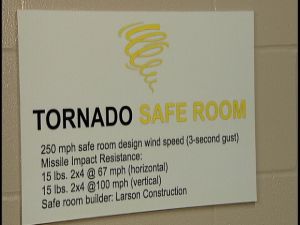
Storm safe shelters built above ground designed to FEMA standards can greatly increase chances of survival. Many Oklahoma schools designed in the last 20 years have storm safe areas that are designed to FEMA standards. These safe areas are constructed  in pods on the interior of a school and able to contain all of the occupants of the school. They are typically designed with steel reinforced poured-in-place concrete walls, reinforced concrete roof and impact resistant metal doors and frames with pressure resistant closing and locking mechanisms.

Many districts have not included storm safe areas in their new schools due to the additional cost or not being able to obtain federal funding thru FEMA.  Many of Moore, Oklahoma's newer schools have storm safe areas. The schools hit by the tornado were older schools that were constructed of brick and concrete block veneer with steel frames. The tornado that hit these schools pulled the metal roof members and deck away from the block walls that used the roof as support. The unsupported lateral stability of these block walls were subjected to 200 mph winds that pushed them into the corridors and classrooms or were knocked over by large steel roof deck panels, beams and other debris. In these type structures with the brittle nature of concrete block and the ductile nature of steel the corridors were not safe.

Why did the Warren Theatre sustain relatively little damage? 

In contrast, the Warren Theatre that was within 200 yards of the direct path of the tornado only sustained cosmetic and light glass and frame damage. The Warren Theatre structural frame and exterior walls are constructed of monolithic, 8" thick, reinforced concrete panels that were facing the direct path of the tornado.  The steel reinforced concrete wall panels withstood large debris forces and winds upward of 200 mph. This system is very good at resisting the lateral forces of debris and wind while the concrete parapets protect the roof edges from the extreme lifting pressures that occur during a tornado. The waterproofing membrane on the theatre roof was sucked off in some areas and no doubt leaks occurred, but relatively little damage compared to other steel and wood frame buildings in the same area.

Rigid Frame Metal Building Systems - Why the adjacent bowling alley was leveled? 

Just across the parking lot from the Warren Theatre not more than 200 yards once stood a large bowling alley. It was constructed of a metal building systems frame, metal wall panels and metal roof deck.  It was engineered like thousands of metal buildings across the nation. The problem with these structures are many including shear resistance, torsion resistance, lateral stability, designed for up to 90 mph winds only. The roof deck on these structures is held on with steel screws that aren't effective at resisting tension and can pull out quickly becoming flying debris and opening the rest of the building to a twisting effect that tears the steel frame apart and throws it up into the tornado.

My hope is that families, community leaders and private businesses will take the time to understand the value of different structural systems and their relative safety. They can then make informed decisions regarding the facilities first cost vs. occupant safety in the event of such a catastrophic event.

For residential safe room plans and additional information you can go to the FEMA web site by clicking on the following link: FEMA Safe Room Construction and Materials Lists.


Monday, April 8, 2013

Conditions for Learning - Can Architecture Support and Enhance These?

Over the last few years there has been much research and discussions about the most important elements found in schools that positively affect student performance.  Often called conditions of learning or C.O.L.  There may be others, but four of the most common are:
  • the presence of clear behavioral expectations
  • the generation of abundant opportunities to build skills through practice
  • the provision of rewards and recognition for students meeting expectations
  • the cultivation of positive relationships between teachers and students built on trust and esteem
Most would agree that there is a statistical correlation between the presence of these conditions and student success at end of term testing.  

One of the challenges in our Learning Environments Studio is to explore the influence and impact of these conditions on the physical environment.  Can we enhance, integrate and improve any or all of these conditions in the physical environment thru the use of technology, graphics, games, lessons, shapes, materials and concepts to improve student performance? We think it can and should be done.  Below are simple and cost effective examples of how these ideas may manifest themselves in a gym. Your thoughts? 


Length, Width, Distance, Movement, Addition concepts enhanced in gymnasium design 
Length, Width, Distance, Movement, Addition concepts enhanced in gymnasium design